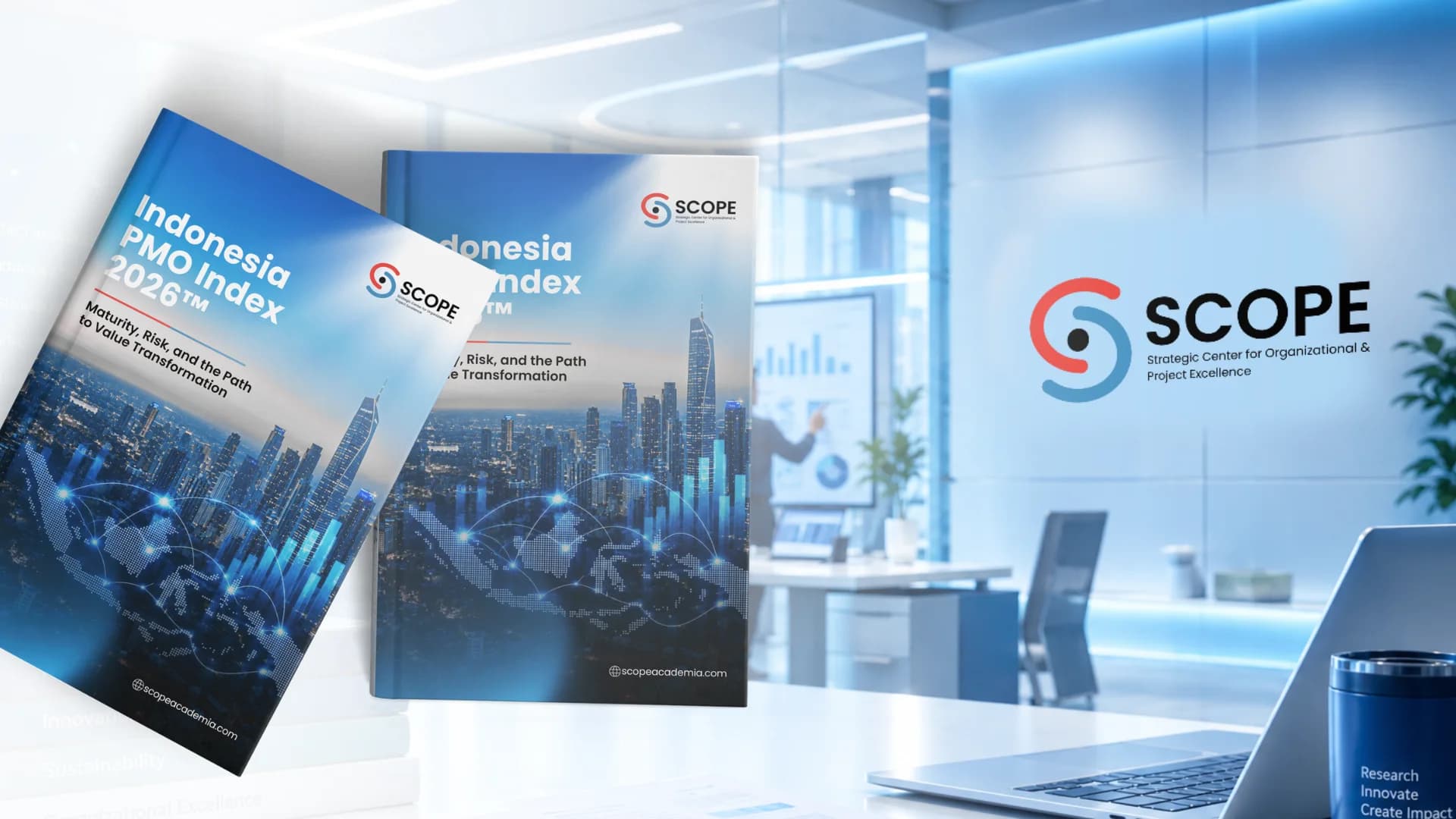
Jakarta, September 17, 2026 — SCOPE, Avenew's applied research center, launched the Indonesia PMO Index 2026 alongside AveXchange 2026 in Jakarta. The Indonesia PMO Index 2026 is Indonesia's first empirical baseline measuring the maturity, risk, and transformation readiness of Project Management Offices nationally. It is also SCOPE's first flagship publication since the center was formally established last month.
Data-Driven Research, Not Assumptions
The Indonesia PMO Index 2026 draws on a national survey of 243 project-based organizations in Indonesia. State-owned enterprises make up 42.4 percent of respondents, national private companies 39.9 percent, and multinational companies 17.7 percent. Respondents from the construction sector account for 53.1 percent, and non-construction sectors for 46.9 percent. The survey evaluated 28 PMO risk factors based on condition, probability, and impact.
The research applies Structural Equation Modeling through Partial Least Squares (SEM-PLS), integrated with the AVERYL Theory and the PMO Lotus Framework, two research frameworks developed by SCOPE.
The Indonesia PMO Index 2026 was authored by Dr. Alin Veronika, S.T., M.T., PMP®, PMI-RMP®, PMI-PMOCP™, IPMO-P®, together with Prof. Dr. Ir. Yusuf Latief, M.T., IPU., and Leni Sagita Riantini, S.T., M.T., Ph.D.
In her foreword, Dr. Alin Veronika explains why the research needed to look beyond maturity level alone.
"The Indonesia PMO Index 2026 was developed to provide an evidence-based view of how PMOs in Indonesia are currently positioned. It examines not only their maturity, but also their capabilities, performance, risk exposure, and readiness for transformation. This broader perspective is important because maturity alone does not fully explain whether a PMO is relevant, adaptive, or capable of creating value for its organization," writes Dr. Alin.
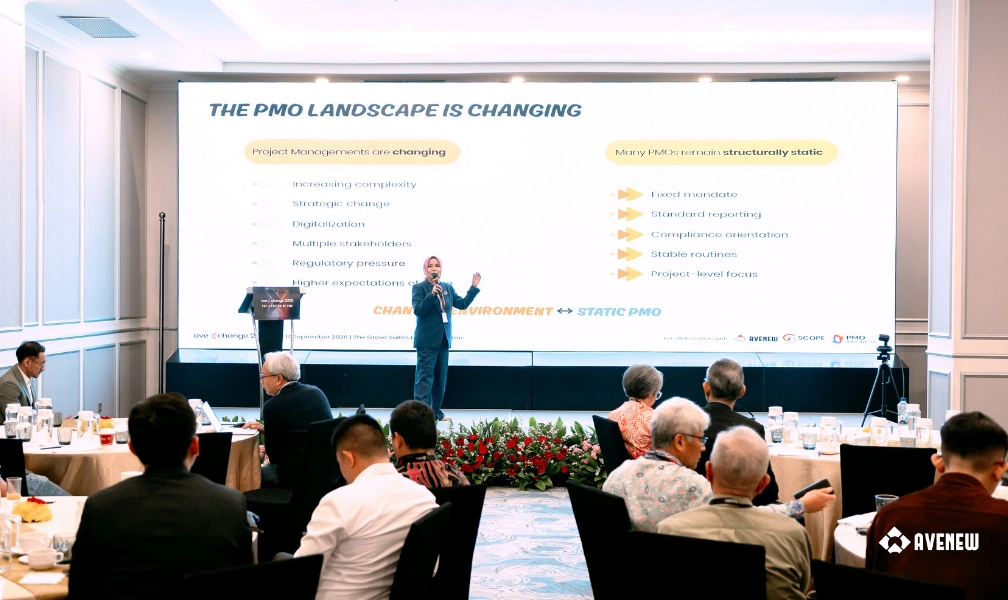
PMOs Exist, but Capabilities Have Not Matured
The Indonesia PMO Index 2026's key finding places the national PMO Maturity Index at 2.19 out of 5.0, positioning PMOs in Indonesia at Level 2, Basic/Repeatable. At this level, PMOs already carry out defined roles and routine activities, but their practices are not yet consistently standardized or institutionalized across the organization.
More than half of PMOs, 50.8 percent, sit at Level 3, Defined, while only 1.5 percent have reached Level 5, Optimized. This means most PMOs in Indonesia already run formal processes, but only a small fraction have developed the strategic and adaptive capabilities needed to operate at the highest level.
The research describes this condition as an institutionalization gap. PMOs in Indonesia have moved past the ad hoc stage, but their capabilities are not yet mature enough to consistently reach Level 3 across the organization. The challenge is no longer adding more activities, templates, or reports. It is integrating existing practices into one coherent system of governance and capability.
Structural Risk Behind Value Leakage
The Indonesia PMO Index 2026 finds that the biggest obstacles to project success in Indonesia are structural, not technical. The three highest-scoring risks are unclear delegation of authority, scoring 12.32 out of 15, informal escalation paths, scoring 12.29 out of 15, and the absence of formal stage-gate mechanisms, scoring 11.73 out of 15. The research also identifies fragmented change control as another significant risk, scoring 12.17 out of 15.
These three structural risks have a direct impact on organizations. Unclear delegation of authority delays decisions and creates strategic misalignment. Informal escalation paths mean interventions arrive too late, driving cost overruns and schedule disruptions. The absence of stage-gates keeps capital tied up in initiatives that are low-value or no longer aligned with organizational strategy.
The research states that when a PMO is confined to an administrative role, the organization does not simply miss out on potential gains. It experiences real value leakage, value that erodes daily due to strategic misalignment and weak governance.
The Widest Gap Is in Strategic Alignment
Among the five capabilities in the PMO Lotus Framework, strategic alignment records the lowest score, at 2.11 out of 5.0. This finding is consistent with a pattern seen throughout the data: most PMOs still evaluate project success using traditional output metrics like schedule and budget adherence, rather than the business value realized after a project is completed.
The SEM-PLS modeling results also confirm that performance and value management risk is the strongest factor driving PMO transformation, with a beta coefficient of 0.360. This finding reinforces the argument that sustained PMO transformation requires a dual-track approach, balancing short-term operational stability with long-term strategic capability building.
Three Recommended Steps for the C-Suite
The Indonesia PMO Index 2026 includes three strategic recommendations for boards and C-level executives.
First, position the PMO as a strategic gatekeeper, granting it formal authority to validate business cases, run stage-gate reviews, and recommend the termination of initiatives that are not aligned with strategy.
Second, shift PMO success metrics from output to outcome, through Benefit Realization Management, so PMOs are no longer measured only on schedule, cost, and scope, but on the business value and return on investment their project portfolio actually generates.
Third, institutionalize risk-driven governance, in which risk signals become the primary trigger for PMO transformation and strategic redirection, turning the PMO from a reactive administrative unit into a proactive risk integrator.
Part of SCOPE's Research Commitment
For SCOPE, publishing the Indonesia PMO Index 2026 marks an important milestone since the center was established. Dr. Ir. Andi Muhammad Ifrad, Head of SCOPE, wrote about his hopes for the report in its foreword.
"As the Head of SCOPE, I hope the Index will serve as more than a measure of PMO maturity. I hope the Indonesia PMO Index 2026 becomes a foundation for broader research, dialogue, and collaboration to advance Project, Program and Portfolio Management and strengthen organizational capabilities in Indonesia to become more adaptive, innovative, sustainable, and resilient," writes Dr. Andi.

He adds that the Indonesia PMO Index 2026 is part of SCOPE's ongoing research agenda, opening the door to further collaboration with academics, practitioners, and industry to test the findings, develop new research questions, and translate empirical evidence into publications, frameworks, and intellectual assets that address organizational needs.
The full Indonesia PMO Index 2026 report is available at scopeacademia.com/research/reports/indonesia-pmo-index-2026.
About SCOPE
SCOPE, Strategic Center for Organizational & Project Excellence, is a center for applied research, innovation, publication, and academic–industry collaboration. It advances organizational and project excellence by generating credible evidence and translating it into frameworks, methods, tools, publications, learning assets, and practical insights.