Having Great Project Managers Is Not the Same as Having Great Organizational CapabilityEvery organization has them.The person everyone calls when a project gets into trouble.The senior project manager who somehow knows how everything works.The PMO leader who remembers why a certain decision was made five years ago.The scheduler with the mysterious spreadsheet nobody else fully understands.The risk expert who can spot problems before everyone else.They are incredibly valuable.Until they leave.Then suddenly, the organization discovers something uncomfortable:
What looked like organizational capability was actually individual dependency.
The Hero Problem
Having talented people is a strength.Depending on a few talented people for everything is a risk.Yet this happens surprisingly often in project organizations.One experienced project manager knows how to navigate senior stakeholders.Another knows how to recover troubled projects.Someone in the PMO understands the entire governance process.Someone else has years of lessons learned stored mostly—in their head.As long as those people remain, the system appears to work.But ask a simple question:
Can the organization perform at the same level without them?
If the answer is no, you may have expertise.But you do not yet have organizational capability.
Capability Development Is Bigger Than Training
Within the PMO LOTUS Framework™, the fifth petal is Capability Development.The obvious interpretation is training.Training matters.But capability development goes much further.It is about how an organization continuously builds, shares, applies, and retains the ability to deliver projects well.That may include:competency development,coaching and mentoring,knowledge management,communities of practice,lessons learned,career pathways,leadership development,and mechanisms for transferring experience from one project to another.The real question is not:
“How many people did we train this year?”
It is:
“What can our organization do better now that it could not do before?”
That is a much higher standard.
Beware of the Knowledge Graveyard
Many organizations have a lessons-learned repository.Some have hundreds of documents.Project closure reports.Post-project reviews.Templates.Presentations.Best practices.Everything carefully stored.And rarely opened again.The knowledge exists.But the organization keeps repeating the same mistakes.Why?Because storing knowledge is not the same as building capability from knowledge.Imagine Project A discovers an important lesson about contractor management.The lesson is documented.Project A closes.Six months later, Project B encounters almost exactly the same problem.Nobody remembers the document.That is not a documentation problem.It is a capability problem.A capable organization does not simply ask:
“Did we capture the lesson?”
It asks:
“Did the next project become better because we learned it?”
Try This: The “What If They Leave?” Test
Think of three people who are critical to how projects work in your organization.Now imagine they all resign tomorrow.What disappears with them?Knowledge?Relationships?Decision-making ability?Technical expertise?Historical context?Informal ways of getting things done?Then ask:
How much of that capability actually belongs to the organization?
This is not about making people replaceable.It is about making knowledge transferable.Strong organizations benefit from exceptional people.But they do not ask exceptional people to carry the entire system on their shoulders
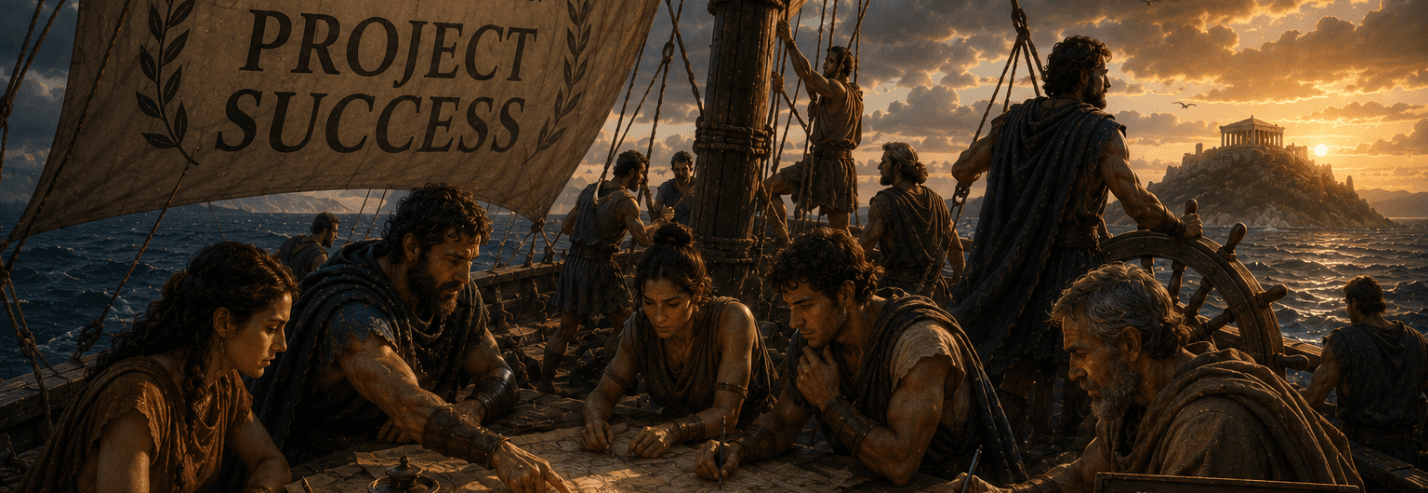
A Strong Crew Learns Together
No captain completes a difficult journey alone.And no PMO creates sustainable impact through processes and tools alone.The five petals of PMO capability now come together:Strategic Alignment gives direction.Governance & Standardization enables decisions and consistency.Performance & Value Management tells us whether progress is creating something worthwhile.Delivery Support turns intention into execution.Capability Development ensures the organization becomes stronger through the journey.But there is something important about capabilities:They are built for the conditions we know.And conditions change.A capability that works perfectly today may become insufficient when strategy shifts, complexity increases, technology changes, or new threats emerge.So how does a PMO know when it needs to change?Sometimes, the answer arrives as a storm.In the next part of The PMO Odyssey, the journey takes a turn:Risk is not always the enemy. Sometimes, it is the signal telling your PMO that it can no longer continue in the same way.