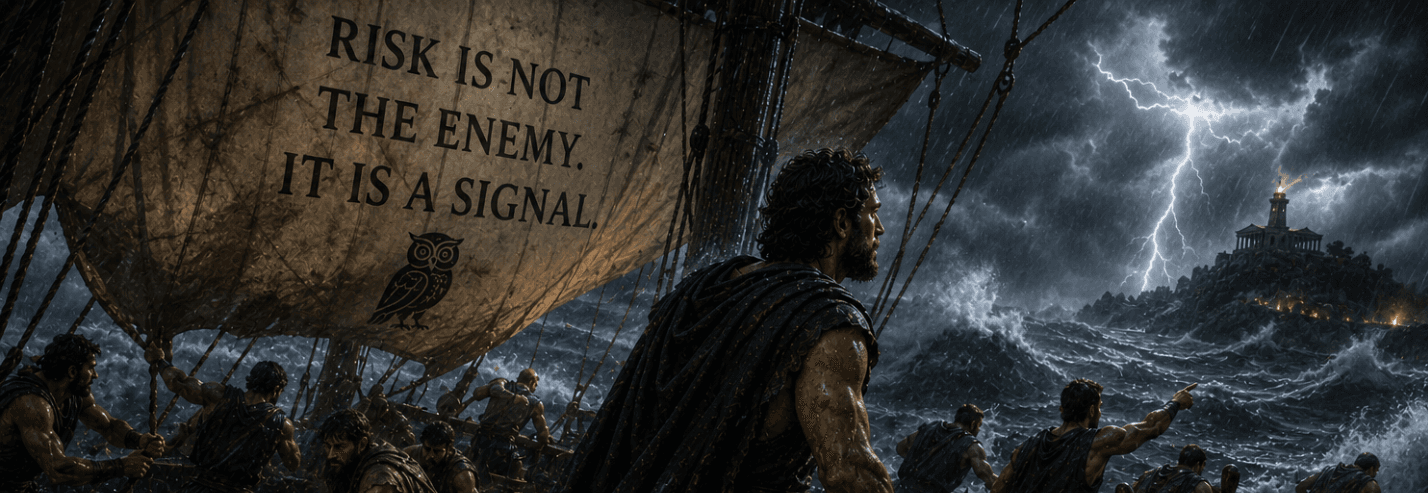
Sometimes, the Risks You Keep Managing Are Trying to Tell You That Your PMO Needs to Change.A good sailor does not blame the sea for changing.The wind shifts.The waves rise.A storm appears where the horizon was clear only hours before.In The Odyssey, storms repeatedly changed the journey.They pushed Odysseus off course, exposed weaknesses, forced difficult choices, and made one thing very clear:
You cannot always navigate new conditions using the same plan.
Organizations face storms too.Strategy shifts.Projects become more complex.Technology disrupts familiar ways of working.Resources become constrained.Stakeholders change.The same project failures begin appearing again and again.And when this happens, many PMOs do what they are trained to do.They manage the risks.But perhaps there is another question worth asking:
What if the risk is trying to tell us something?
When the Same Risk Keeps Coming Back
Imagine an organization where projects repeatedly suffer from delayed decisions.The PMO responds.A new escalation process is created.More governance meetings are scheduled.Additional reporting is introduced.For a while, things improve.Then the same problem returns.Another project.Another delay.Another escalation.Another corrective action.At some point, we should stop asking:
“How do we manage this issue better?”
and start asking:
“Why does our system keep producing this issue?”
Perhaps the problem is not the project.Perhaps decision authority is unclear.Perhaps governance no longer fits the complexity of the portfolio.Perhaps the PMO does not have enough influence to resolve cross-functional decisions.What appears to be a recurring project risk may actually be evidence of a deeper capability gap.
Not Every Risk Needs Transformation
This distinction matters.A supplier delay does not mean you need to redesign the PMO.Neither does one missed milestone.Projects will always have risks.Most can—and should—be managed through normal project and portfolio risk processes.But some risks behave differently.They repeat.They appear across multiple projects.They survive corrective actions.They grow as the organization becomes more complex.Or they reveal that existing PMO capabilities can no longer respond effectively to what the organization now requires.These are not just risks to manage.They are signals to investigate.Within the PMO LOTUS Framework™, this is where risk takes on a different role.Risk can become a trigger for transformation.
From Risk Register to Transformation Signal
Consider a few recurring patterns.Projects consistently struggle to demonstrate strategic relevance.Is that simply a project-selection problem?Or is Strategic Alignment capability too weak?Decision bottlenecks appear across the portfolio.Is that another escalation issue?Or does Governance & Standardization need to change?Dashboards are full of data, yet leaders still discover problems too late.Is the solution another KPI?Or is there a deeper gap in Performance & Value Management?The same resource conflicts disrupt multiple strategic projects.Do we keep solving them one by one?Or is Delivery Support no longer adequate for portfolio complexity?Experienced project managers leave and performance drops dramatically.Is that just a retention problem?Or has the organization failed to build sustainable Capability Development?The risk itself does not automatically give us the answer.But it gives us something valuable:
a reason to look deeper.
Try This: The Recurring Risk Test
Look at the major risks and issues from your projects over the last two or three years.Not just one project.Look across them.Then ask:
Which problems keep coming back?
Which appear across multiple projects or business units?
Which have received corrective actions but never truly disappear?
Which are becoming more serious as the organization changes?
Now ask the most important question:What PMO capability would need to become different—not simply better—to reduce this pattern?That last question moves the conversation from risk management to transformation.
Do Not Waste the Storm
A storm is dangerous.But it also reveals things calm water can hide.Weak coordination.Slow decisions.Poor visibility.Capability gaps.Dependencies nobody noticed.Systems that worked only when conditions were predictable.The goal is not to transform every time something goes wrong.The goal is to recognize when repeated or emerging risks are telling us:
The way we currently operate is no longer enough.
That is a very different way of thinking about PMO transformation.We do not transform because transformation is fashionable.We do not transform because a new technology appears.And we certainly do not transform simply because someone wants a new PMO org chart.We transform when the organization needs capabilities that the current PMO can no longer provide effectively.The storm is the signal.What we do with that signal determines what happens next.Because when conditions change, there are only two choices:Keep navigating the same way—or transform how you navigate.In the next part of The PMO Odyssey, we confront the question at the heart of this entire journey: