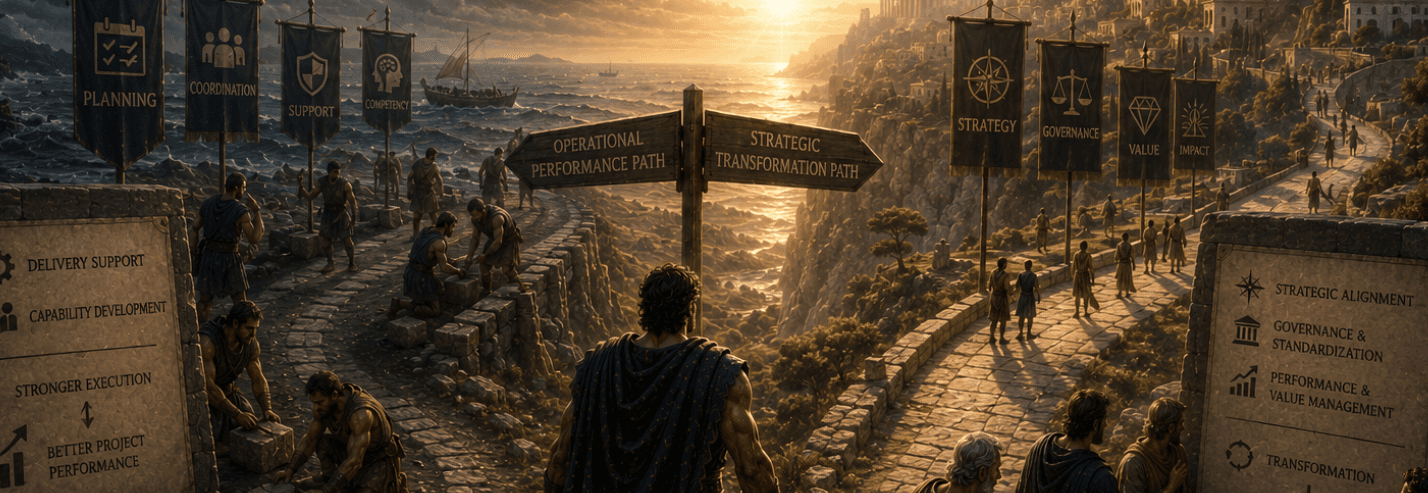
Not Every PMO Capability Creates Impact in the Same Way
Imagine two PMOs.The first improves project controls.Schedules become more reliable.Reporting becomes clearer.Project teams receive better support.Performance improves.The connection feels straightforward:
Better capability → Better performance.
Now imagine another PMO.It becomes more involved in strategic alignment.It strengthens governance.It begins challenging portfolio priorities and shifting the conversation from project outputs toward organizational value.But performance does not immediately improve.Why?Because some capabilities can improve the way projects operate directly.Others require something deeper to change first.This distinction became one of the most interesting insights from our research into PMO capabilities, risk, transformation, and performance.There may not be just one road to PMO performance.There may be two.
Road One: The Operational Performance Path
Some PMO capabilities are close to the everyday reality of project execution.They help projects plan better.Coordinate better.Solve problems faster.Build stronger project competencies.Improve the consistency of delivery.When these capabilities become stronger, the effect can often be seen relatively directly in project and PMO performance.Think about Delivery Support.If the PMO improves integrated scheduling, resource coordination, cross-project visibility, or issue support, projects can perform better.Or Capability Development.If project professionals become more competent and organizational knowledge is better transferred, execution can improve.This is what we can think of as the:
Operational Performance Path
Capability → Performance
The logic is relatively intuitive.Strengthen the ability to execute—and execution improves.But not every capability works this way.
Road Two: The Strategic Transformation Path
Now consider capabilities such as Strategic Alignment, Governance & Standardization, or Performance & Value Management.Strengthening these capabilities may require more than simply improving an existing PMO service.Why?Because they often change how the organization itself operates.Strategic Alignment may change how projects are selected and prioritized.Governance may change decision rights and accountability.Performance & Value Management may shift executive conversations from:
“Is the project on schedule?”
to:
“Should we still be investing in this?”
These are not small operational adjustments.They may require new roles.Different behaviors.New decision processes.Different information.New technology.Greater PMO influence.In other words:
transformation.
This creates a second route:
Strategic Capability → Transformation → Performance
The capability creates the potential.Transformation converts that potential into organizational impact.
The Capability Trap
This distinction explains something PMOs sometimes find frustrating.They invest in becoming “more strategic”—but nothing significant changes.The PMO introduces portfolio management.Creates strategic dashboards.Adds benefits tracking.Establishes new governance structures.Yet executives continue making decisions exactly as before.Projects continue being selected the same way.Old behaviors remain.The new capability exists.But the surrounding system has not transformed.This is the capability trap:Having a capability does not automatically mean the organization is capable of using it.A strategic PMO cannot simply install strategic capabilities like software.The organization may need to change with them.
Try This: Which Road Are You On?
Choose one PMO capability you are currently trying to improve.Then ask:Can this capability improve performance within the way our organization currently works?If yes, you may be on an Operational Performance Path.Improve the capability.Strengthen execution.Measure the result.But then ask:Does this capability require people to behave differently, decisions to move differently, processes to change, or technology to enable something fundamentally new?If yes, capability improvement alone may not be enough.You may be on a Strategic Transformation Path.And that means the question is no longer simply:
“How do we strengthen this PMO capability?”
It becomes:
“What must transform for this capability to create value?”
One Destination. Different Roads.
This is why PMO transformation should never begin with a generic maturity checklist.Not every capability gap requires the same response.Some gaps need improvement.Some need development.Some need transformation.And some may not matter nearly as much as we think.The challenge is understanding which capability matters, in which organizational context, through which path to performance.That is where the PMO journey becomes more than capability building.It becomes a system.Capabilities create the foundation.Risk tells us when the existing system may no longer be enough.Transformation changes how those capabilities work.Performance tells us whether any of it actually made a difference.And when those elements begin working together, something changes.The PMO is no longer simply stronger in individual areas.
The whole system begins to bloom.
In the next part of The PMO Odyssey, we ask:What does a high-impact PMO actually look like when all the petals begin working together?