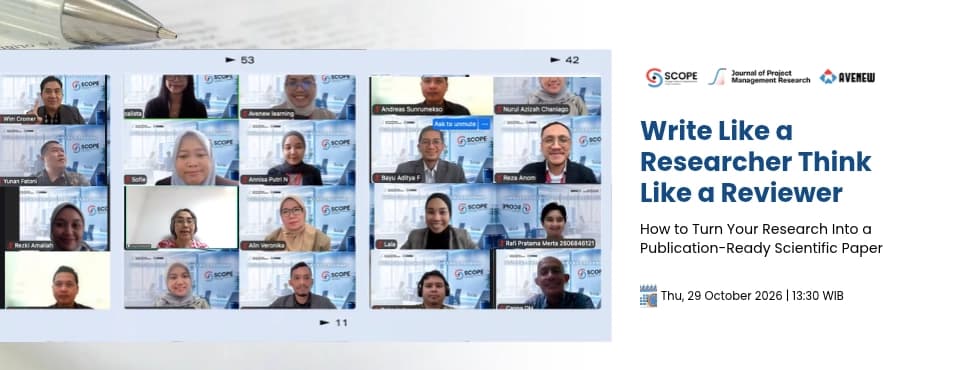
Jakarta, October 29, 2026 — SCOPE, Strategic Center for Organizational & Project Excellence, held an online webinar titled Write Like a Researcher, Think Like a Reviewer via Zoom Meeting on Thursday, October 29, 2026, at 1.30 PM WIB. The webinar was a collaboration between SCOPE, the Journal of Project Management Research (JPMR), and Avenew, open to the public free of charge.
The webinar grew out of a problem many researchers face. They hold valuable findings but struggle to turn them into papers that make it through peer review, especially for journals indexed in Scopus. Participants learned to write with a researcher’s clarity while anticipating the critical eye of a reviewer, so their work becomes ready for submission to reputable journals.
From Researchers’ Struggles to the Publication Gap
The session opened with remarks from Dr. Alin Veronika, PMP, PMI-RMP, PMI-PMOCP, IPMO-P, Founder of Strategic Center of Organizational & Project Excellence. She explained the background behind the webinar’s topic.
“Today’s topic comes from our own experience as researchers who often struggle to get published, especially in Scopus-indexed journals. This webinar became a space to learn from researchers among us who are accustomed to conducting research and publishing in Scopus, namely Dr. Andi Muhammad Ifrad and Prof. Susy,” said Dr. Alin.
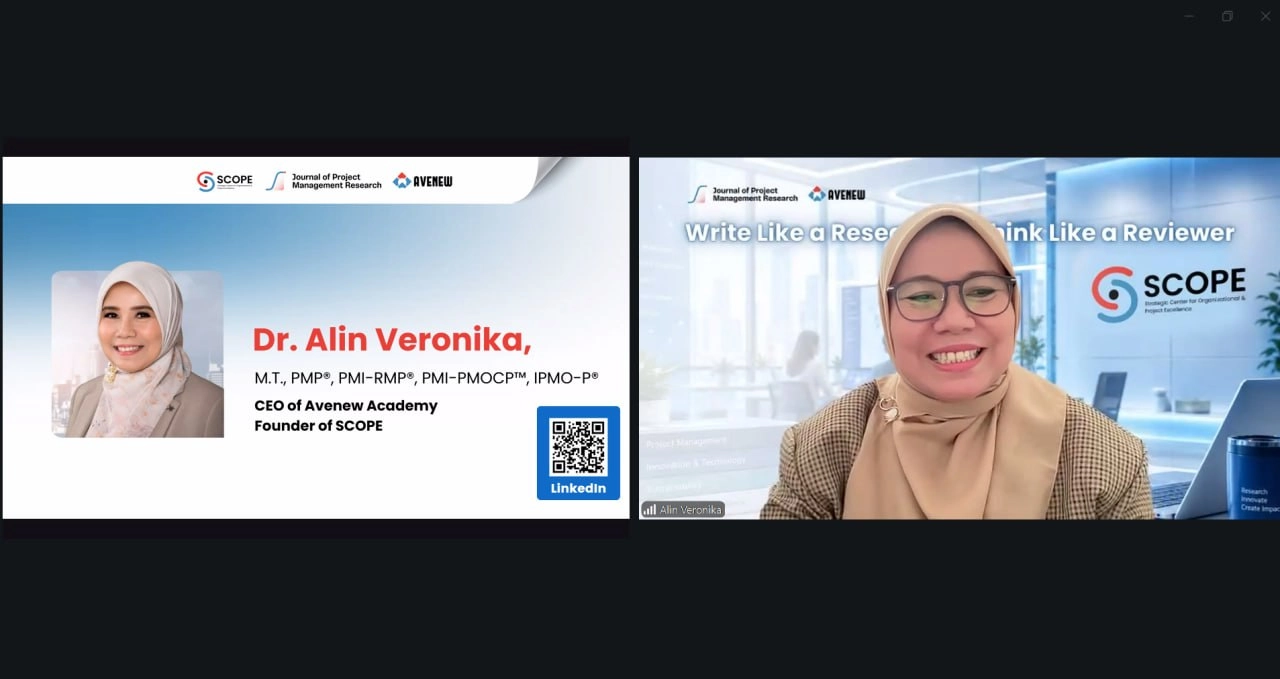
“I hope that through this webinar, everyone can learn to write as a researcher and think as a reviewer, so that whenever you face difficulty in writing, finding a topic, following research trends, or going through every stage of journal submission until acceptance, you can learn directly from our speakers,” she added.
Dr. Alin also introduced the Journal of Project Management Research as one of SCOPE’s publication channels. “SCOPE also runs the Journal of Project Management Research, a reputable project management research journal that uses a double peer-reviewed system. JPMR is currently in the process of SINTA and Scopus indexing, and anyone who submits before December 2026 still pays zero APC, so it remains free. You can reach JPMR directly through its website,” she said.
The session was then moderated by Bayu Aditya Firmansyah, CEO of Avenew Indonesia and a member of SCOPE’s Research Advisory Council.
Putting Empirical Evidence Above Subjective Claims
The first speaker, Dr. Ir. Andi Muhammad Ifrad, S.T., M.T., Head of SCOPE and a researcher at the Faculty of Engineering, Universitas Indonesia, opened his session with the core principle of scientific argumentation.
“The main principle in a scientific argument is to put empirical evidence above subjective claims. Researchers must avoid overclaiming by making sure every conclusion is genuinely supported by the data obtained,” said Dr. Andi.
He also stressed the role of the discussion section in a scientific manuscript. “The purpose of the discussion section is to connect your findings with existing literature, whether to support, refute, or extend prior knowledge, while explicitly linking them back to your original research question,” he explained.
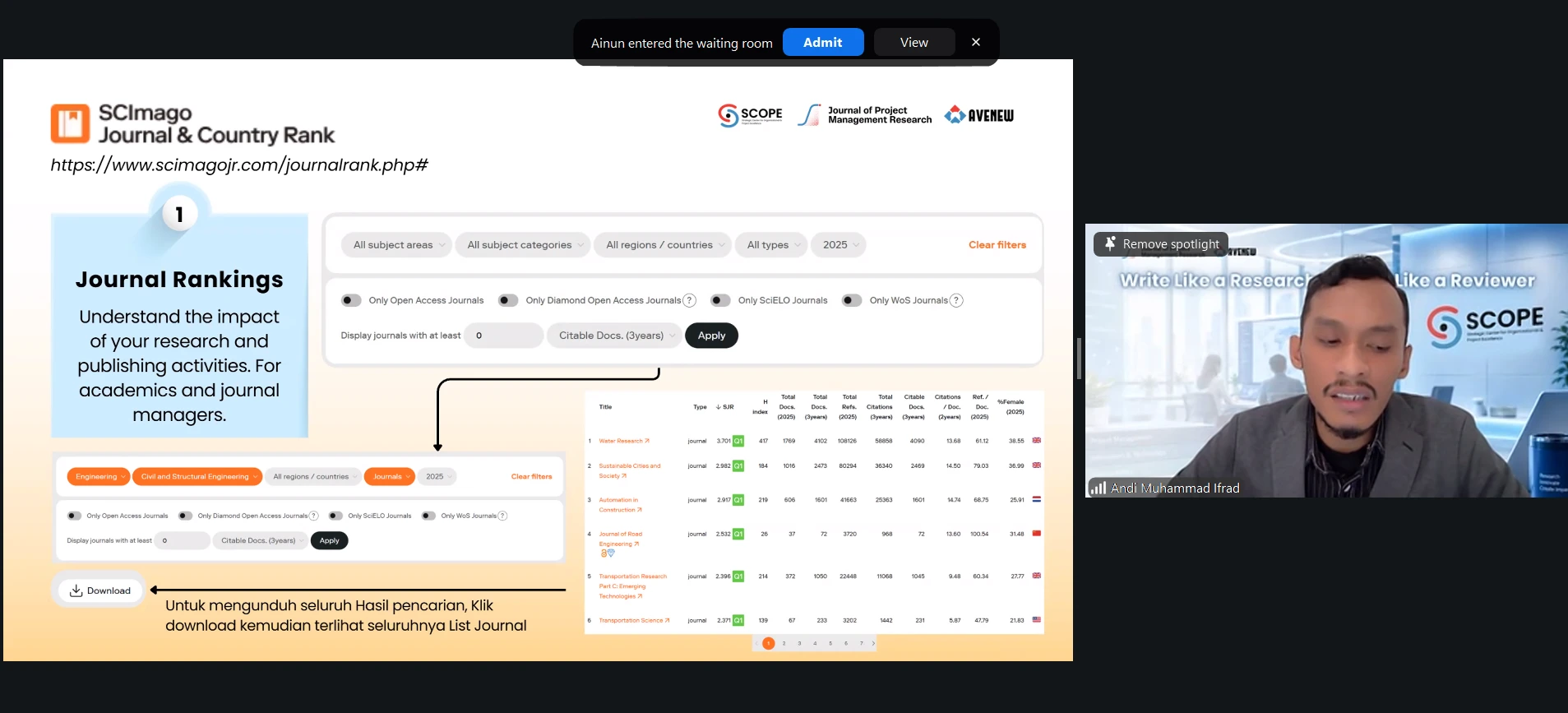
On the use of AI in academic writing, Dr. Andi sees it as a tool for refining sentence structure and recognizing language patterns, not for generating content or performing complex analysis. He warned that AI detectors look for specific patterns, and careless use of AI tools can violate publisher policies.
Dr. Andi also underlined the importance of distinguishing between initial assumptions or hypotheses and the research objective. In his view, when findings diverge from initial expectations, it does not always mean the research has failed. That divergence often reveals a valuable research gap or novelty for the scientific community.
A Strong Research Gap and Ethics as the Foundation of Publication
The second speaker, Prof. Dr. Susy Fatena Rostiyanti, S.T., M.Sc., Vice Rector and Professor of Construction Management at Institut Teknologi PLN and a member of SCOPE’s Research Advisory Council, highlighted the importance of a well-tested research gap.
She emphasized that researchers must ensure a research gap truly exists, rather than presenting a shallow case study. A claim that a study has never been done in Indonesia must be backed by strong literature evidence, so it does not come across as too simplistic to a reviewer.
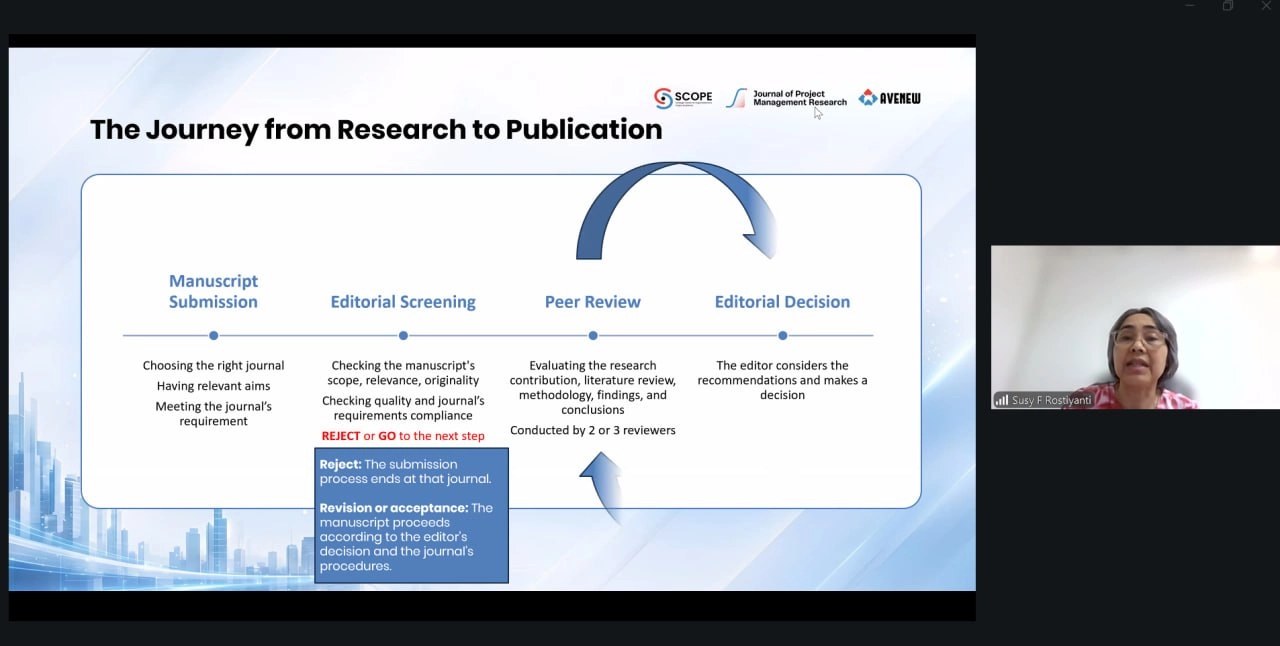
“Writing a literature review is not just about summarizing what other researchers have said. Instead, a writer must conduct a critical analysis by comparing viewpoints, identifying differing limitations across studies, and finding points of alignment that strengthen their own manuscript,” said Prof. Susy.
Prof. Susy also shared an experience that underscored the importance of research integrity. She once encountered a case where an author reused the same data for two different studies submitted ten years apart, a reminder that researcher integrity is the foundation of academic publication.
On the role of reviewers, she stressed that reviewers are not there to tear a manuscript down, but to improve its quality. Authors need to respond to reviewer comments professionally, for example by using a response table to track and explain every revision made to the manuscript.
On AI, Prof. Susy sees it as a discussion partner that can help explore ideas. However, she cautioned against letting AI dominate or take over the analytical work that should remain the author’s own intellectual responsibility, while still paying attention to each journal’s AI usage policy.
Practical Tools for Publishing in Reputable Journals
Throughout the webinar, participants learned how to structure their research into a publication-ready paper with a clear flow and storyline, strengthen their manuscripts with meaningful research gaps, sound arguments, and clear contributions, and navigate the publication process from manuscript preparation through submission and revision. Whether a student, an early-career researcher, or an academic aiming to publish in higher-impact journals, this session offered practical insights straight from those who write and evaluate scientific papers.
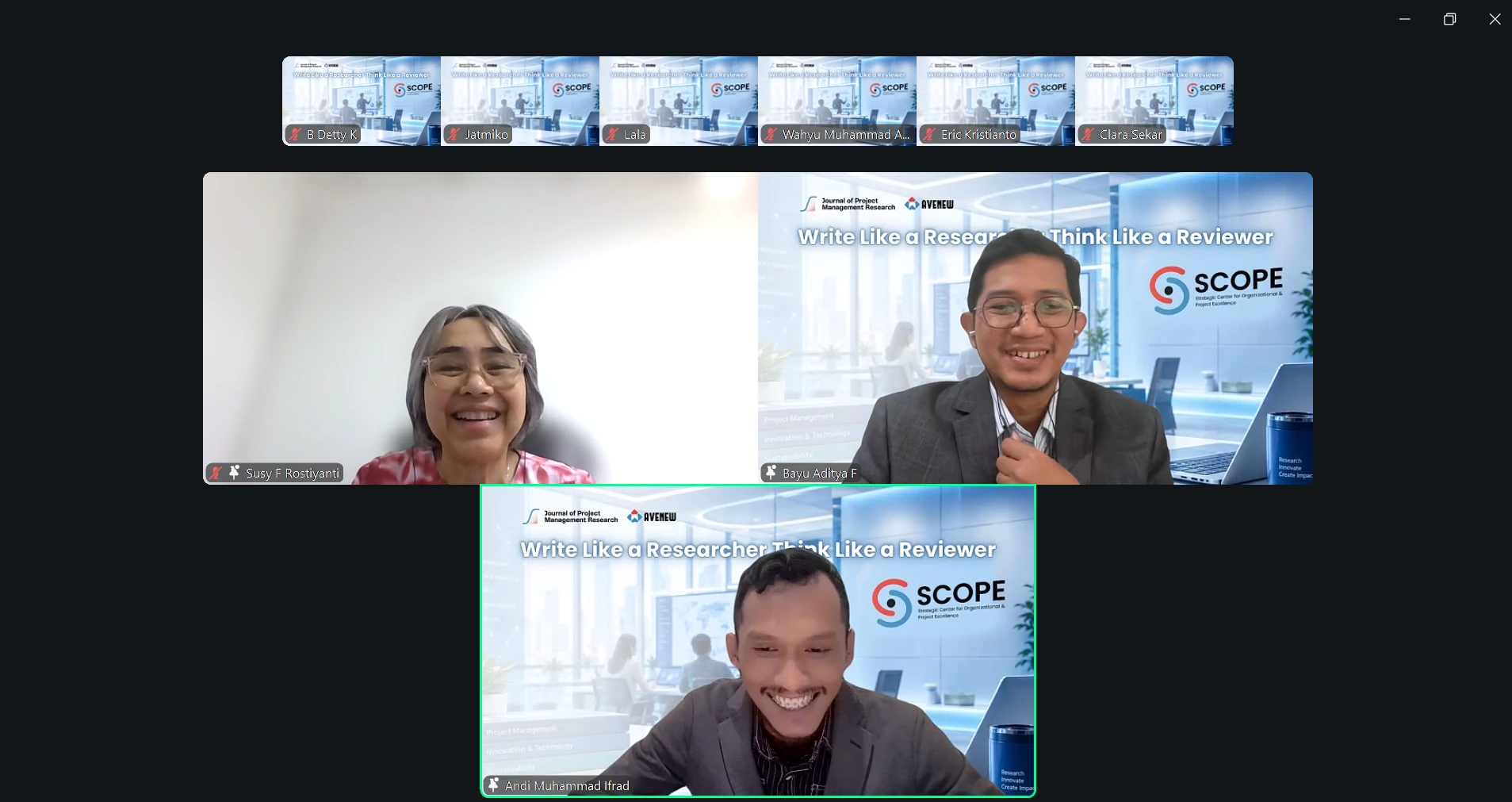
Both speakers bring relevant experience to the topic. Prof. Susy has authored over 70 academic research papers on construction management, public-private partnerships, and sustainable construction, earning over 1,000 academic citations worldwide, and has reviewed for the Journal of Infrastructure Systems, a Q2 journal with an SJR of 0.591. Dr. Andi completed his doctoral degree at Universitas Indonesia in just 2.5 years, innovated seven intellectual properties in asphalt materials and pavement engineering, was awarded five research grants over two years, published eight Scopus-indexed research papers, and served as a peer reviewer for Construction and Building Materials, a Q1 journal with an SJR of 2.097.
About SCOPE
SCOPE, Strategic Center for Organizational & Project Excellence, is a center for applied research, innovation, publication, and academic-industry collaboration. It advances organizational and project excellence by generating credible evidence and translating it into frameworks, methods, tools, publications, learning assets, and practical insights. SCOPE sits within the Avenew Group ecosystem, led by Dr. Alin Veronika as CEO of Avenew Academy.